

Canada welcomes thousands of visitors every year, including parents and grandparents arriving under the Super Visa program. One of the most common questions applicants ask is: Should I buy Super Visa Insurance or regular Travel Insurance?
While both plans provide emergency medical coverage, they serve different purposes and offer different benefits. More importantly, only one of them satisfies the insurance requirements set by the Government of Canada for Super Visa applications.
In this guide, we’ll compare Super Visa Insurance vs Travel Insurance Canada, explain the key differences, and help you determine which plan meets IRCC requirements.
What Is Super Visa Insurance?
Super Visa Insurance is a specialized medical insurance policy designed specifically for parents and grandparents applying for a Canadian Super Visa.
The Canadian government requires applicants to have private health insurance from a Canadian insurance provider before a Super Visa can be approved.
Key Features of Super Visa Insurance
- Minimum $100,000 emergency medical coverage
- Coverage for hospitalization and healthcare services
- Valid for at least one year from the date of entry
- Must be purchased from a Canadian insurer
- Covers medical emergencies, accidents, and unexpected illnesses
- Required for Super Visa application approval
Without valid Super Visa Insurance, an application may be refused by Immigration, Refugees and Citizenship Canada (IRCC).
What Is Travel Insurance?
Travel Insurance is a general insurance policy designed for tourists, business travelers, vacationers, and short-term visitors.
It typically covers:
- Emergency medical expenses
- Trip cancellation
- Trip interruption
- Lost baggage
- Flight delays
- Emergency evacuation
Travel Insurance is ideal for visitors staying in Canada for a short duration but is generally not designed to meet the mandatory requirements of the Super Visa program.
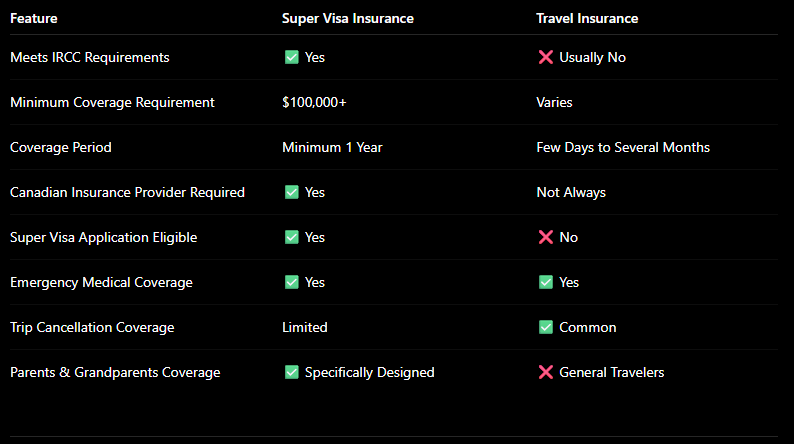
Super Visa Insurance vs Travel Insurance: Quick Comparison
IRCC Requirements for Super Visa Insurance
To qualify for a Super Visa, applicants must provide proof of health insurance that meets specific government guidelines.
IRCC Insurance Requirements Include:
✔ Coverage of at least $100,000
✔ Valid for a minimum of one year
✔ Covers healthcare, hospitalization, and repatriation
✔ Issued by a Canadian insurance company
✔ Active and available for review at the port of entry
If a travel insurance policy does not satisfy all these conditions, it will not meet IRCC requirements.
Why Travel Insurance Usually Doesn’t Qualify
Many travelers mistakenly believe that standard travel insurance can be used for a Super Visa application.
In reality, most travel insurance policies:
- Offer shorter coverage periods
- May not provide $100,000 minimum coverage
- Are often issued by international providers
- Focus on trip-related benefits rather than long-term medical protection
As a result, standard travel insurance is generally not accepted as proof of insurance for Super Visa applications.
When Should You Buy Super Visa Insurance?
You should purchase Super Visa Insurance if:
- You’re applying for a Parent or Grandparent Super Visa
- You want to stay in Canada for extended periods
- You need coverage that complies with IRCC regulations
- You want protection against costly healthcare expenses in Canada
Medical treatment in Canada can be expensive for visitors. Even a short hospital stay can result in significant expenses without insurance coverage.
When Is Travel Insurance a Better Option?
Travel Insurance may be suitable if:
- You’re visiting Canada as a tourist
- You’re traveling for business purposes
- Your stay is short-term
- You need trip cancellation and baggage protection
For standard visitor visas, travel insurance can provide adequate protection depending on your travel plans.
Cost Comparison: Super Visa Insurance vs Travel Insurance
Super Visa Insurance
Factors affecting premiums:
- Age of applicant
- Coverage amount
- Medical history
- Deductible selected
- Duration of coverage
Travel Insurance
Factors affecting premiums:
- Trip length
- Destination
- Traveler’s age
- Coverage limits
- Optional add-ons
While Super Visa Insurance cost more upfront, it provides the level of coverage required by Canadian immigration authorities.
Benefits of Choosing Super Visa Insurance
Financial Protection
Emergency healthcare costs in Canada can be substantial. Super Visa Insurance helps cover:
- Hospital stays
- Emergency treatment
- Diagnostic tests
- Ambulance services
- Prescription medications
Immigration Compliance
The biggest advantage is meeting IRCC requirements and avoiding application delays or refusals.
Peace of Mind
Parents and grandparents can enjoy their stay knowing they have comprehensive medical protection throughout their visit.
How to Choose the Right Super Visa Insurance Plan
Before purchasing a policy, compare:
- Coverage amounts
- Deductible options
- Pre-existing condition coverage
- Refund policies
- Insurance provider reputation
- Claim settlement process
Working with an experienced insurance advisor can help you find the most suitable and affordable plan.
Final Verdict: Which Plan Meets IRCC Requirements?
If you’re applying for a Canadian Super Visa, the answer is clear:
✅ Super Visa Insurance meets IRCC requirements.
❌ Regular Travel Insurance generally does not.
Although both policies provide medical protection, only Super Visa Insurance is specifically designed to satisfy the mandatory insurance conditions required for Super Visa approval.
Choosing the right coverage ensures compliance with Canadian immigration rules while protecting your loved ones from unexpected medical expenses during their stay in Canada.
Conclusion
Understanding the difference between Super Visa Insurance and Travel Insurance is crucial before applying for a Canadian Super Visa. While Travel Insurance works well for tourists and short-term visitors, parents and grandparents seeking long-term stays must obtain Super Visa Insurance that complies with IRCC requirements.
By selecting the appropriate coverage, you can improve the chances of a successful Super Visa application and enjoy greater financial security throughout your stay in Canada.
Super Visa Insurance is specifically designed for parents and grandparents applying for a Canadian Super Visa and meets IRCC requirements. Travel Insurance is intended for tourists and short-term visitors and may not satisfy Super Visa eligibility criteria.
In most cases, no. Standard Travel Insurance policies generally do not meet IRCC requirements, such as minimum coverage limits, one-year validity, and coverage from a Canadian insurance provider.
IRCC requires applicants to have:
A minimum of $100,000 in emergency medical coverage
Coverage valid for at least one year from the date of entry
Coverage for healthcare, hospitalization, and repatriation
A policy issued by a Canadian insurance company
The minimum required coverage is $100,000, but many applicants choose higher coverage amounts for added protection and peace of mind.
No. For Super Visa applications, the insurance policy must typically be issued by a Canadian insurance provider and meet all IRCC requirements.
Yes. Valid Super Visa Insurance is a mandatory requirement for obtaining and maintaining eligibility for a Canadian Super Visa.
Some Super Visa Insurance plans cover stable pre-existing medical conditions. Coverage depends on the insurer, policy terms, and the applicant’s medical history.
Yes. Many Canadian insurers offer monthly payment plans, making coverage more affordable for families sponsoring parents and grandparents.
You should renew or extend your coverage before it expires to maintain continuous medical protection during your stay in Canada.
If parents or grandparents are entering Canada under the Super Visa program, Super Visa Insurance is the better and required option because it complies with IRCC regulations and provides long-term medical coverage.
Related guide: Travel Insurance Canada
Official 2026 reference: Government of Canada — Super Visa health insurance requirements.